✓ USA-Manufactured Fiberglass
Sewage Basin Tank
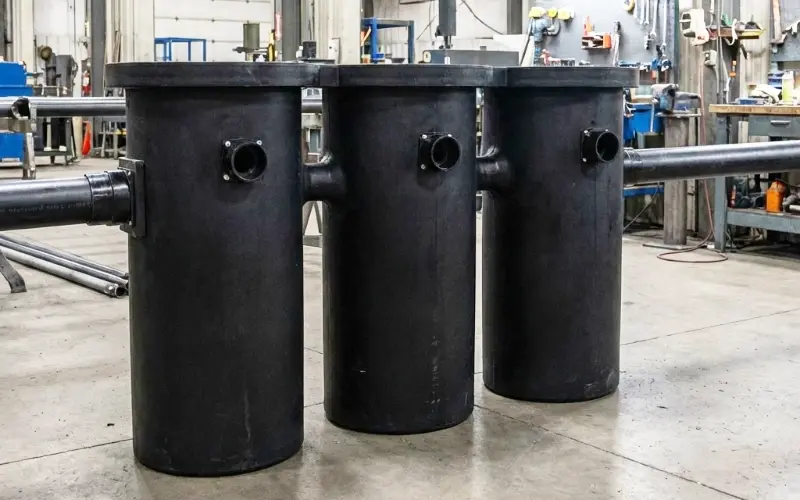
Fiberglass sewage basin tanks are below-grade collection vessels that hold wastewater until a submersible pump moves it to the next point in the system. Corrosion-resistant FRP construction handles the wet, chemically aggressive conditions where concrete and steel degrade over time.
Available in diameters from 18" through 120", commonly specified for municipal lift stations, commercial sewage pump basins, and sump applications. One Clarion sources these from U.S. manufacturers and helps match the right size and configuration to your project.
Spec List
- Material: Fiberglass (FRP), chop hoopwound process with commercial grade resin
- Diameters: 18" through 120" (11 standard sizes)
- Depth options: Multiple per diameter — confirm during quoting
- Wall thickness: 5/32" through 3/8" depending on size and depth
- Anti-float collar: Included standard — round or square options on larger diameters
- Inlet/outlet: Accepts Adaptaflex and cast iron hubs
- Warranty: 1 year
Features
- E-glass filament construction using chop/hoop winding process
- Durable, watertight, and lightweight relative to precast alternatives
- Corrosion-resistant FRP construction suited for wastewater environments
- Standard diameters from 18" through 120" with depth options
- Basin extensions available to reach required depth
- Multi-section configurations for deeper or larger applications
- Covers, lids, and anti-float options available
Applications
- Lift stations and wet well pump station setups
- Sewage pump basins for commercial and site systems
- Sump pit and sump pump system collection
- Septic tank sump and effluent transfer (project-dependent)
- Municipal and residential sewage ejector systems
- Below-grade wastewater collection for industrial facilities
Sewage Basin Tank Details
A sewage basin tank is a below-grade chamber that collects wastewater by gravity flow and holds it until a submersible pump activates to move it to the next point in the system, typically a sewer main, treatment facility, or secondary collection point. In lift station and wet well pump station setups, the basin sits in an excavated pit with inlet pipes feeding wastewater in from one or more directions and a pump mounted inside to discharge it out.
The tank operates on a simple cycle: wastewater enters, rises to a set level, triggers the pump float switch, and is discharged. When the level drops to the off-set point, the pump shuts down and the cycle repeats. Duplex setups use two pumps alternating duty to extend service life and provide backup if one unit fails.
Fiberglass construction keeps the vessel watertight and resistant to the hydrogen sulfide and other corrosive byproducts that form in wastewater environments. Whether used as a sewage pump basin for a commercial building or a sump pit in a residential or light industrial setting, the basin is sized based on inflow rate, pump capacity, and required cycle time, all of which are typically determined by the project engineer before the basin is specified.
Specialist Support for Your Storage Project
Talk with a specialist for practical guidance and equipment recommendations.
Frequently Asked Questions
Common questions about FRP wet wells, sewage basins, and what to expect when sourcing through One Clarion.
What is a FRP wet well or a sewage basin?
A sewage basin is a below-grade collection chamber that holds wastewater until it is pumped to the next point in the system. FRP versions are commonly specified for their corrosion resistance and lighter weight compared to precast concrete, and are a core component of lift station and sewage pump basin setups.
How are inlet and outlet locations determined?
Connection locations, sizes, and seal or boot requirements should be confirmed before ordering. Our Sales Specialists can help review what is needed for your configuration during the quoting process.
What information do you need to quote a sewage basin?
Most useful: application type, basin diameter and depth from plans, inlet and outlet sizes and locations, access requirements, and any site condition notes such as traffic loading or groundwater. If you are still in early planning, we can work with what you have.
Do wet wells require anti-float or buoyancy planning?
When groundwater or a high water table is present, an empty basin can be subject to hydrostatic uplift. Anti-float collars and anchoring options are available — the appropriate solution should be specified by the project engineer based on site conditions.