Mine Pond Dewatering for Precious Metals
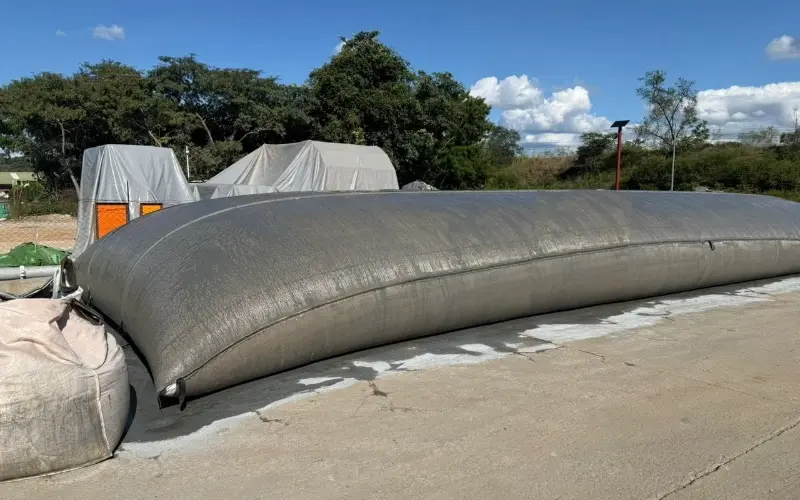
In 2026, One Clarion supplied geotextile dewatering tubes for a precious metals mining operation in Southern Africa. The project used mine pond dewatering to recover fine concentrate that had been stored unfiltered on site, proving the process on a pilot tube before moving to full scale.
Pilot trial before full production
On-site bench and flocculant testing
Fines at 95% passing 75 µm
Slurry density of 1.65 RD
Supplied from in-region inventory
Delivered in two staged shipments
Project Overview
One Clarion specializes in dewatering for precious metals operations, including gold, silver, and platinum group metals, from concentrate and fines recovery to pond cleanout and thickener underflow. On this project, the operation normally dewaters its concentrate through pressure filters. Operating constraints had forced it to send unfiltered material to on-site ponds, and the metallurgical team needed a way to recover that fine concentrate from those ponds. The site had not used geotextile dewatering tubes before.
Our approach
Our Project Specialists started with a project data questionnaire covering volume, particle size, slurry density, percent solids, pump rates, and the available laydown area, then joined a video call with the site team and the manufacturer's dewatering group. With a tight laydown footprint and no prior tube experience, we recommended proving the process on a pilot tube, with a dewatering field specialist on site, before any production order.
Why it matters?
A pilot run turns assumptions into site data: how much polymer the material needs, how fast it dewaters, when the cake can be excavated, and how many tubes the pumped volume will fill. That gives the owner a basis for an accurate quote and budget, and it confirms tube dewatering as a low-tech, high-volume companion to an existing filter press circuit.
The challenge
The operation had valuable fine concentrate sitting unfiltered in storage ponds and no proven way to recover it outside its pressure filter circuit. The material's particle size and slurry density raised real questions about fines retention and polymer demand, and the site had no history with geotextile tubes to answer them. A small laydown footprint and pressure to get a trial running quickly meant the approach had to be proven at pilot scale, on a short timeline, before committing to a production order.
Concentrate held in ponds
The site's pressure filters are its primary dewatering step, but operating constraints had sent unfiltered concentrate to storage ponds. That material had to be recovered, dewatered, and dried before it could be loaded onto trucks for transport.
Very fine slurry, no tube history
The pond material ran 95% passing 75 µm at a slurry density of 1.65 RD, and the team had never used geotextile tubes. Fines that fine can pass through the fabric before a filter cake forms, so permeability, polymer response, and capacity per tube all needed answers before scaling.
Tight laydown and a short trial window
The project questionnaire showed a small footprint for tube laydown. The metallurgical team was also under pressure to get a trial running quickly, and field specialist availability in the region was limited to a narrow window.
The solution
We started small. A dewatering field specialist from the manufacturer's team brought a mobile lab to site, ran bench tests on fabric compatibility, dewatering rate, and sludge specific gravity, and screened flocculants before the pilot tube went in. The pilot was fed with thickener underflow that already carries the site's coagulant and flocculant filter aid, and it produced clean filtrate from the start. With a positive field report in hand, the site moved to production tubes made from the same woven geotextile as the pilot, shipped from in-region inventory in two staged deliveries in March 2026. In service, the team pumped from both the ponds and the thickener. Pond material had lost its floc in storage, so the larger production tubes saw some early fines blow-through until the internal filter cake built up, while thickener feed filled tubes faster; filter aid dosing and contact time became the levers for pond-fed batches. Pumping, polymer dosing, laydown preparation, and excavation were by others.
Recovered concentrate from the ponds
Recovered pond-stored concentrate by pumping it into geotextile dewatering tubes for low-tech, high-volume dewatering ahead of drying and truck loading.
Answered the fine-particle questions first
Answered the fine-particle questions on site with bench testing and flocculant screening before the pilot tube was filled.
Proved it, then scaled
Proved the process on a pilot tube inside the specialist's available window, then scaled to full production with tubes shipped from in-region stock.
Specialist Support for Your Storage Project
Talk with a specialist for practical guidance and equipment recommendations.