Slurry Dewatering
Plan polymer, laydown, and filtrate handling around the right geotextile tube system from the start.
What is Slurry Dewatering?
Slurry dewatering is the separation of suspended solids from process water so each stream can be handled on its own terms. On precious metals operations the most common case is tailings dewatering, alongside thickener underflow and sediment pumped from settling and process water ponds. The targets are a consolidated solids cake that can be stacked, hauled, or reprocessed, plus filtrate clean enough to recirculate as process water or route to wastewater storage and treatment. Geotextile dewatering tubes are a passive tailings dewatering technology that works without a belt press or centrifuge on site. Slurry dewatering is not a single product purchase: the tube performs only as well as the conditioning ahead of it and the containment and storage behind it.
Solids dewatering performance starts with flocculation. A polymer flocculant, typically an anionic or cationic polyacrylamide selected by jar testing on a representative sample, binds fine solids into floc large enough for the geotextile to retain while filtrate drains through the fabric. Beyond polymer selection, the right system depends on slurry volume, inlet percent solids, target cake solids, pump rate, available laydown footprint, climate and drying time, and where the filtrate goes next. Discharge permits and water use licenses may also set limits on turbidity, suspended solids, and residual polymer before any filtrate leaves the site.
Who Works In This Field?
Mine process engineers balancing tailings volume against the capacity left in existing ponds. Environmental managers who need filtrate to meet discharge or reuse limits on the first sampling round. EPCM project teams scoping tailings pond dewatering or a process pond cleanout on a fixed schedule and budget. Procurement leads who need tube fabric, configuration, and documentation matched to the project specification before the order is placed.
The Problem They Face
The wrong dewatering specification fails in ways that compound on site. Polymer chosen without bench testing leaves fines in the filtrate and blinds the fabric. Tube layouts that ignore solids volume or footprint run out of capacity mid-campaign. Laydown cells that cannot capture the filtrate breach containment, and filtrate with no planned destination stalls pumping altogether. Every one of these issues lands on the project engineer long before the campaign wraps.
Explore Our Solutions
Geotextile Dewatering Tubes
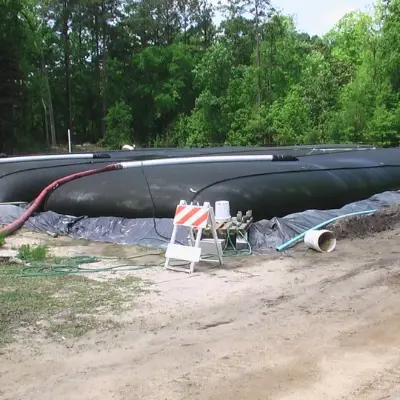
Geotextile tube dewatering is a passive system: conditioned slurry is pumped into high-strength woven geotextile tubes, the fabric retains flocculated solids, and filtrate drains to the laydown cell. Tube circumference, length, and fabric are selected from your solids volume, inlet and target percent solids, polymer response, and the laydown footprint actually available, so the layout carries the full campaign instead of running out of capacity midway. Tubes accept repeated fill cycles as solids consolidate, and suit tailings ponds, process water ponds, and dredged slurry where mechanical separation on site is not practical.
Helpful Codes & Regulations
Slurry dewatering projects involve two sets of requirements: the discharge rules that govern the filtrate, and the material standards that define how the tube fabric and containment liner perform. The specific requirements that apply depend on where the filtrate goes, what the slurry contains, and the jurisdiction. Permitting authorities may require sampling data, material certifications, or containment drawings before approving a discharge or a dewatering cell, and projects outside the US follow national and regional water use licensing. A Project Specialist can help confirm which standards and documentation requirements apply to your project.
-
NPDES: Permit program covering filtrate discharged to US surface waters.
-
40 CFR Part 440: Effluent limitations for ore mining and dressing, including gold, silver, and platinum ores.
-
ASTM D4751: Apparent opening size, which governs fine solids retention in the fabric.
-
ASTM D4491: Permittivity, the rate water passes through the geotextile
-
ASTM D4595: Wide-width tensile strength of the tube fabric under fill pressure.
-
GRI-GM13: Material and test specification for HDPE geomembranes in the laydown cell, where an HDPE liner is specified.
Specialist Support for Your Storage Project
Talk with a specialist for practical guidance and equipment recommendations.
Frequently Asked Questions
Common questions about sizing, polymer selection, filtrate quality, and solids handling for Slurry Dewatering applications.
How are tailings dewatering chemicals selected?
Slurry chemistry varies with ore type, clay content, pH, dissolved metals, and residual process reagents, so a polymer that flocculates one stream can fail on another. Bench testing confirms floc formation, release water clarity, and a starting dose before anything is ordered, and the field run confirms the final dose.
How do geotextile tubes reduce haul-off weight?
Dewatering cuts haul-off weight by removing water before the solids leave site. Filled tubes stay in place while the solids consolidate toward the target percent solids, then are opened and the cake is excavated for disposal, stacking, or reprocessing at a fraction of the slurry's original volume. Drying time depends on climate, solids type, and target percent solids, so plan the haul route and final placement before the first fill. For a field example, see our precious metals dewatering project.
How clean is filtrate from geotextile tube dewatering?
Filtrate quality depends mostly on how well the slurry is flocculated and on the fabric's apparent opening size. Well-conditioned slurry typically releases low-turbidity water, but whether it meets reuse or discharge limits is confirmed only by sampling, and some sites add a polishing step ahead of discharge.
How do I size a slurry dewatering system?
Sizing depends on slurry volume, inlet percent solids, target cake solids, solids specific gravity, pump rate, and campaign duration. Those set total tube capacity and fill cycles, and the available footprint sets the layout. A Sales Specialist can help you work through these variables based on your site conditions.