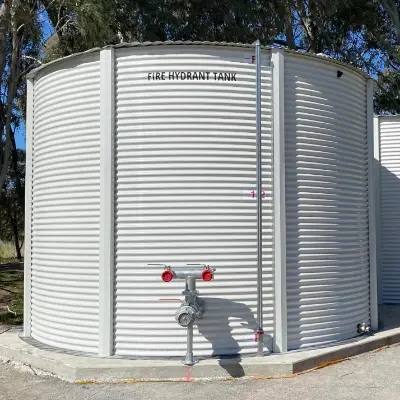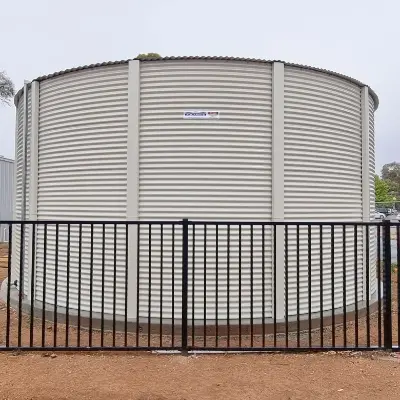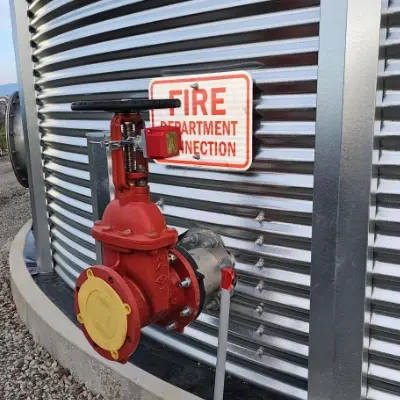
There is no universal formula that spits out a fire water tank size. Storage capacity is the output of a design basis: required fire flow, demand duration, refill assumptions, and the fire protection system the tank serves. This guide walks through each input, explains why two similar sites can land on very different numbers, and shows how a gallon range starts pointing toward specific tank types. When you have a working range, our Tank Volume Calculator and Sales Engineers can help you turn it into a buildable spec.
Sizing Starts With the Design Basis
If you search for a fire water tank sizing chart, you will find plenty of them, and almost none of them will match what your authority having jurisdiction actually approves. That is not because the charts are wrong; it is because fire water storage capacity is not a lookup value. It is the result of a design basis that is specific to your building, your fire protection system, your water supply, and your jurisdiction.
This article is the sizing companion to our overview of Fire Protection Water Storage and builds on the compliance side covered in Fire Water Storage Requirements for Commercial Sites. The requirements piece answers "what will I be asked to provide?" This one answers the next question: "how do I turn those requirements into a tank size, and what does that size start telling me about the tank itself?"
The Inputs That Determine Fire Water Storage Size
Every credible sizing exercise starts with the same four inputs, even when the numbers behind them vary widely.
Required fire flow is the rate of water your protection scheme has to deliver, typically expressed in gallons per minute. For sprinklered buildings, this usually comes from the hydraulic demand of the sprinkler system calculated under NFPA 13, plus any hose stream allowance the design requires. For sites relying on hydrants or rural water supply, the flow may instead come from methods such as NFPA 1142 or an insurance carrier's needed fire flow calculation. Insurers can, and often do, require flows above the code minimum, so the governing number is whichever demand is highest.
Duration is how long that flow must be sustained. Duration is tied to hazard classification: a light-hazard office generally carries a shorter duration than an ordinary-hazard warehouse or a high-piled storage occupancy, and durations across common designs can range from well under an hour to several hours. Flow multiplied by duration is the raw demand volume, and it is the largest driver of tank size by far.
Refill and replenishment assumptions determine how much of that demand must sit in storage before the event starts. Some designs are permitted to credit a reliable automatic inflow, such as a strong municipal connection or a high-yield well, against part of the demand. Many jurisdictions allow no credit at all and require the full demand volume in storage. NFPA 22 also addresses how quickly a tank must be capable of refilling after use, which can influence supply-side decisions even when it does not change the tank size.
System design basis covers everything that separates nominal volume from usable volume. Dead storage below the tank outlet or vortex plate cannot be counted toward fire demand. Freeboard, ice allowances in cold climates, and dedicated fire reserves in combined-use tanks all add capacity above the calculated demand. A tank that stores domestic or process water alongside the fire reserve needs a design that guarantees the fire volume is always protected, which typically means a larger vessel than the fire demand alone would suggest.
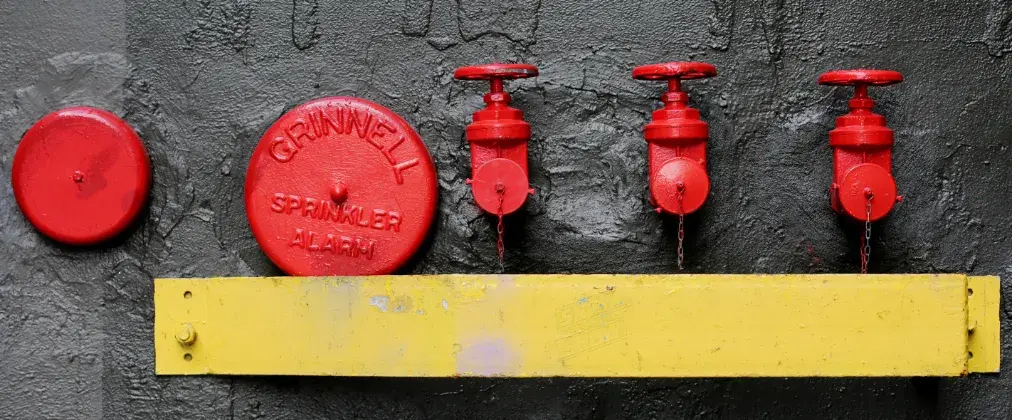
Tank size is an output of the design basis, not the starting point. Get the four inputs right and the gallons follow.
Why Sizing Varies From Site to Site
It is common for two buildings of similar size and use to end up with noticeably different storage targets, and understanding why prevents a lot of wasted quoting effort.
Occupancy and commodity classification drive both flow and duration, so a warehouse storing paper products and one storing plastics can diverge sharply even with identical footprints.
Water supply reliability is often the biggest swing factor. A site on a strong municipal main may only need storage to cover the gap between available supply and required demand. A site at the end of a weak main, or on well water, may need to store the entire demand volume. This is why an identical building can need a modest tank in one location and a very large one a few miles away.
Finally, jurisdiction and insurance layer their own interpretations on top. Authorities having jurisdiction differ in how they apply reduction credits, whether they accept refill assumptions, and how they treat combined-use storage. Insurance carriers, particularly for highly protected risk programs, frequently set demands above code minimums. The practical takeaway: never benchmark your tank size against a neighboring site or a previous project. Benchmark it against your own design basis, and confirm the interpretation with the reviewing authority early, before the number hardens into a purchase.
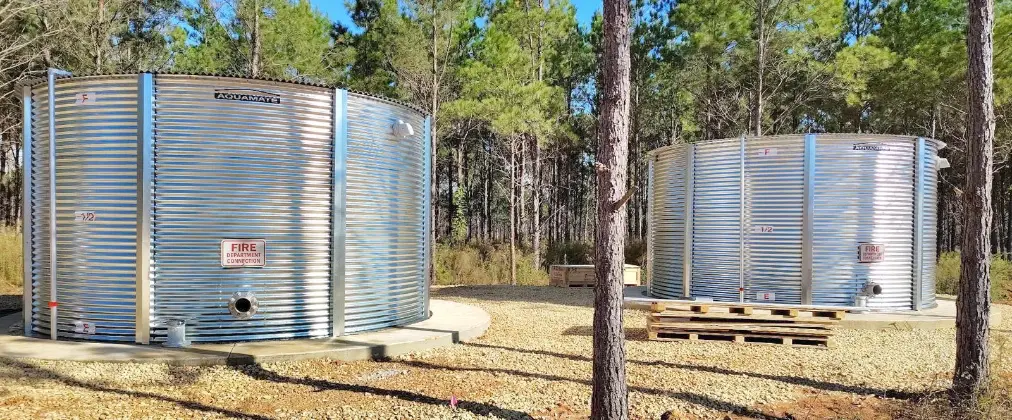
Never benchmark your tank against the site next door. Benchmark it against your own design basis and your own jurisdiction.
How Site Conditions Shape the Storage Target
Once the design basis produces a volume, the site decides what shape that volume can take. Site conditions rarely change how much water you need; they change the geometry, and sometimes the product category, required to hold it.
Footprint is the first constraint. The same 100,000 gallons can be reached with a wide, short tank or a narrow, tall one, and a tight equipment yard pushes the design taller or toward rectangular modular formats that use corners conventional cylinders waste. Height brings its own limits: zoning restrictions, wind and seismic design, visual impact requirements, and the suction conditions your fire pump needs all put a practical ceiling on how tall you can go.
Access matters twice. During construction, crane reach, staging room, and delivery clearances can rule out certain tank formats before price is ever discussed. After commissioning, the tank needs clear access for fire department connections and for the ongoing inspection program every fire tank carries; our Article: Fire Water Tank Inspection Checklist is a useful preview of what that access has to support for the life of the asset.
Climate affects both capacity and cost. Cold regions may need heaters, insulation, and an ice allowance that adds required volume. Hot, corrosive, or coastal environments push liner, coating, and material decisions that begin narrowing product families on their own.
Future expansion deserves a decision, not an assumption. Sizing ahead of current demand costs more today but avoids a second mobilization; planning for a future second tank keeps capital lower now but consumes yard space you have to protect. Some tank formats also expand more gracefully than others, which becomes part of the product conversation in the next section.
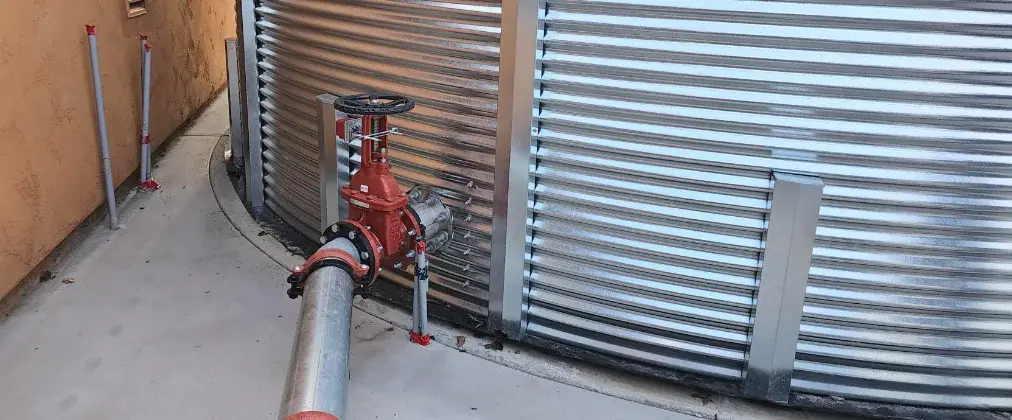
Site constraints rarely change how much water you need. They change the shape the water has to take.
How a Size Range Narrows Product Fit
Here is the useful part of finishing the sizing exercise: once flow and duration produce a gallon range and the site defines its constraints, much of the catalog falls away on its own. The ranges below are directional, not absolute; every family overlaps at the edges, and no single tank type is the right answer for every site.
At the large end of the spectrum, Bolted Steel Tanks are a frequent landing point. Field-bolted construction supports very large capacities, this carries a long acceptance history with fire authorities, and is typically built to recognized standards such as AWWA D103.
In the broad middle of the market, Corrugated Steel Tanks often win on installed cost and schedule. Being lined tanks they excel for storing food-grade NSF 61 potable water. Incremental model sizing makes it straightforward to select a tank just above the calculated demand, and installation is generally faster than heavier fabricated formats.
Where corrosion resistance or water quality considerations lead the conversation, Aboveground FRP Tanks serve small to mid-range fire volumes. They are commonly used where carbon steel is susceptible to corrosion and where polyethylene may not provide the structural rigidity or temperature tolerance required by the application.
When the footprint is tight, irregular, indoors, or on structure, Modular FRP Panel Tanks change the geometry problem entirely. Panel-built rectangular tanks assemble through standard access openings and can be configured to fit the space available rather than forcing the space to fit a cylinder.
One category deserves a clear boundary: water trailer tanks are a temporary and mobile measure only. They have a legitimate role covering a construction phase, an interim gap during tank replacement, or a short-term project need, but they are not a permanent fire water storage solution and should never be positioned as one.
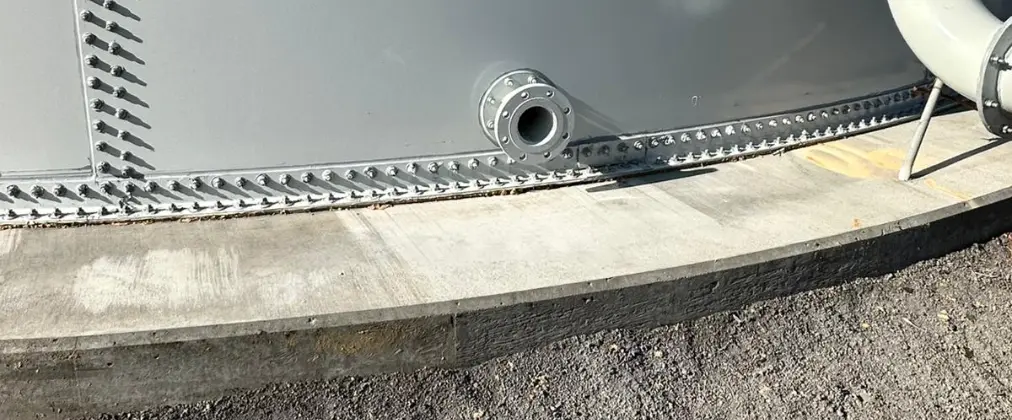
Once flow and duration produce a gallon range, half the catalog usually falls away on its own.
When to Use a Calculator, and When to Call a Specialist
Two tools finish the sizing job, and they do different work.
Use our Tank Volume Calculator when you have a target volume and need to test geometry: which diameter and height combinations reach the demand, what fits the pad you actually have, and how nominal capacity compares to the usable volume above dead storage. It is the fastest way to move from a gallon figure to two or three realistic tank envelopes you can sketch onto a site plan.
Talk to a Sales Engineer when the inputs themselves are unsettled. That includes situations where the AHJ has not confirmed flow, duration, or refill credits; where a combined-use tank has to protect a dedicated fire reserve; where NFPA 22 appurtenances, freeze protection, or seismic anchorage will materially affect the design; or where two product families both work on paper and the decision needs installed-cost, schedule, and site-specific judgment. Those are exactly the conversations where a sizing mistake is cheapest to catch, because nothing has been fabricated yet. One boundary worth stating plainly: final capacity and system design rest with the fire protection engineer of record and your authority having jurisdiction. Our role is to help you match the approved target to the tank that fits it.
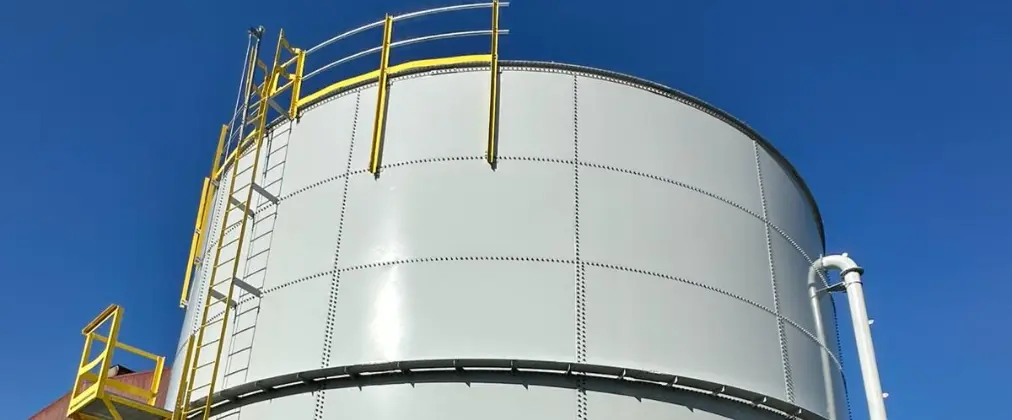
A calculator turns gallons into geometry. A Sales Engineer turns geometry into a solution.